Munich, 2026.
It wasn’t raining. That would’ve been too poetic.
It was just an ordinary evening. People walking past with shopping bags. Cyclists weaving through traffic. A couple arguing softly near the tram stop. Nothing mystical. Nothing dramatic.
Liv Singh Gill sat outside a corner café he often visited when he felt restless. He had ordered black coffee because he told himself serious writers drank it that way. Truth was, he didn’t even like it. But it felt honest.
He had turned forty three weeks ago.
Forty. The age used to sound ancient when he was twenty. Now it felt unfinished.
He opened his notebook. Blank page. Again.
He had started writing at twenty. That part he remembered clearly. It wasn’t ambition. It wasn’t money. It wasn’t fame. It was loneliness.
He had been born and brought up in Germany, but something in him never felt settled. He thought in English. He dreamed in English. He wrote in English. But publishers told him his voice was “hard to place.” Too introspective for commercial. Too direct for literary circles. Too emotional for critics. Too serious for entertainment. He tried translating himself. That felt worse. Twenty years of sending manuscripts. Twenty years of small encouragements and larger rejections.
Twenty years of believing that one day, someone somewhere would read him and feel seen. He worked small jobs. Freelance pieces. Editing for others. Odd shifts. Barely enough to stay afloat. His finances were thin, fragile. But his health was strong. He trained. He ran. He kept his body sharp. It was the one thing he could control. Sometimes he would look at himself in the mirror and think, At least I have this. Good health. Good shape. A face that aged slowly. He was grateful for that. Nothing else. He stirred his coffee though he hadn’t added sugar. And then someone pulled out the chair opposite him. He didn’t look up at first.
“May I?” the voice asked.
Smooth. Almost amused.
Liv raised his eyes.
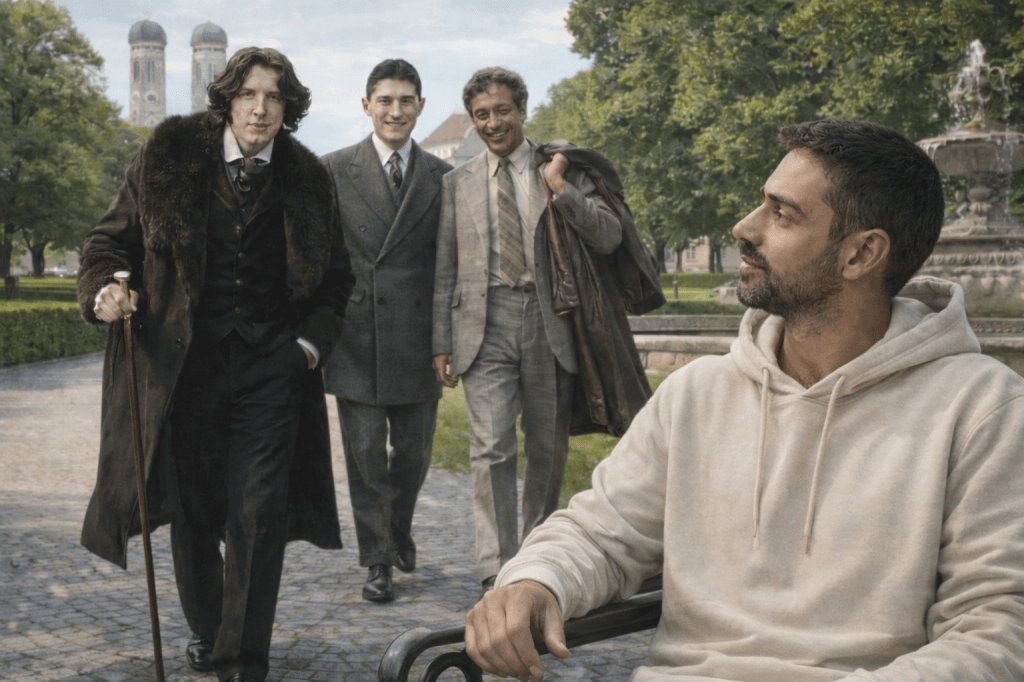
The man sitting across from him looked composed in a way modern men no longer did. Elegant coat. Calm posture. Sharp eyes that looked like they had already decided something about the world. Liv blinked.
“This table is taken,” Liv said automatically.
“Of course it is,” the man replied. “By destiny, boredom, and a slight lack of editorial discipline.”
Liv stared. Behind the elegant man stood two others. One thin, pale, observant — as if studying the shape of Liv’s thoughts.
The other quiet, with eyes that held storms and silence together. Liv felt something in his chest tighten. “No,” he whispered.
The elegant man smiled gently.
“Yes.” “I’m tired,” Liv said. “If this is a hallucination, at least make it kind.”
The elegant man leaned back.
“My dear boy,” said Oscar Wilde, “hallucinations are rarely kind. They are simply honest.”
Liv’s breath went shallow.
The thin one stepped forward slightly.
“Honesty,” he said softly, “is a burden most men cannot afford.”
Liv knew that voice without ever hearing it in person.
Franz Kafka.
And the third — the quiet one — finally spoke.
“We have waited nineteen years.”
It was Shiv Kumar Batalvi.
Liv looked around. No one else reacted. The café continued as normal.
“You’re not real,” Liv said again, though weaker this time.
Kafka’s mouth curved slightly.
“Reality is negotiable,” he replied.
Oscar folded his hands.
“We were sent.”
“By who?” Liv asked.
“An angel,” Shiv said simply.
Oscar added, “A rather discreet one. Doesn’t like attention.”
Kafka said quietly, “The angel noticed persistence.”
Liv let out a breath he didn’t realize he was holding.
“You’ve come to fix my life?”
All three shook their heads.
“No,” Shiv said. “We are not permitted to touch your love life.”
Kafka added, “Nor your poverty.”
Oscar sighed dramatically.
“Nor your career, in the way you imagine it.”
“Then why are you here?” Liv asked.
“To polish you,” Oscar replied.
Liv almost laughed.
“Polish me? I’ve been polishing for twenty years.”
Oscar tilted his head.
“No. You’ve been surviving.”
Kafka looked at Liv carefully.
“You confuse endurance with refinement.”
Shiv sat down quietly beside them.
“You began writing at twenty,” Shiv said. “Why?”
“Because I had no one to talk to,” Liv answered honestly.
“Good,” Kafka said. “Loneliness produces depth.”
Oscar waved his hand lightly.
“Depth is charming. But depth without structure is a diary.”
Liv felt that land harder than he expected.
“I’ve worked,” Liv insisted. “I’ve revised. I’ve studied.”
“Yes,” Oscar said kindly. “But you still seek approval in every paragraph.”
Silence.
Liv’s jaw tightened.
Kafka spoke again.
“You fear obscurity.”
“Of course I do,” Liv snapped. “I don’t want to die unknown.”
Kafka’s eyes softened.
“Unknown by whom?”
Liv didn’t answer.
Oscar leaned forward.
“My dear Liv Singh Gill — may I call you Liv? Excellent — obscurity is merely anonymity without romance. It is not failure.”
Shiv’s voice dropped lower.
“I died at forty.”
Liv looked at him sharply.
“I know.”
Oscar glanced at Shiv.
“Yes, terribly inconvenient timing.”
Shiv ignored him.
“I left when my work was still burning,” Shiv said. “You are forty now. You are still breathing. That is not a small thing.”
Liv swallowed.
“I feel behind.”
“Behind whom?” Kafka asked.
“Other writers. People my age who are published, recognized.”
Oscar smiled faintly.
“Comparison is the most vulgar form of self-harm.”
Kafka added, “Many published writers are spiritually unfinished.”
Shiv leaned in.
“Your suffering is not unique,” he said gently. “But your voice is.”
Liv stared at his notebook.
“My finances are terrible,” he admitted. “I barely make ends meet.”
Oscar shrugged.
“So did I.”
Kafka nodded.
“So did I.”
Shiv’s lips moved faintly.
“Most poets do.”
Liv laughed despite himself.
“That doesn’t make it better.”
“No,” Kafka said. “But it makes it common.”
Oscar observed him carefully.
“You are healthy,” Oscar said. “You train. You care for your body. That is wisdom most artists ignore.”
Liv nodded.
“I’m grateful for my health. Nothing else.”
Kafka looked at him thoughtfully.
“Health is time.”
Shiv added, “Time is pages.”
Oscar concluded, “Pages are immortality rehearsing.”
The café lights flickered slightly as evening deepened.
Liv asked quietly, “Will I ever be discovered?”
Kafka answered first.
“If it is written in your destiny, yes.”
Oscar added, “If not, you will still have written something true.”
Shiv’s voice was steady.
“Writing is not a transaction. It is a calling.”
Liv felt anger rising.
“Easy for you to say. You’re legends.”
Oscar’s eyes sharpened.
“Legends are simply writers who died at the correct time.”
Kafka almost smiled.
“Or who were read after death.”
Shiv’s expression turned inward.
“Glory does not warm you at night.”
Liv went quiet.
He had expected them to praise him. To validate him. To say he deserved more.
Instead they were dismantling him gently.
“What do I do then?” Liv asked finally.
Oscar answered calmly.
“Cut every sentence that is trying to impress.”
Kafka added,
“Keep every sentence that scares you.”
Shiv said,
“Write as if you are already forgotten.”
Liv felt something shift.
Oscar continued.
“Stop performing for the invisible audience. Write for the page.”
Kafka said softly,
“Do not chase readers. Let your work become undeniable.”
Shiv looked at him long.
“Your pain is not special. But your honesty can be.”
Liv’s eyes stung unexpectedly.
“I’m tired of failing.”
Kafka leaned back.
“Failure is the apprenticeship.”
Oscar smirked.
“And you have served a very long one.”
Shiv placed his hands together.
“You needed these nineteen years.”
“Nineteen?” Liv asked.
“Yes,” Kafka said. “We were instructed to wait.”
“Why?” Liv demanded.
Oscar looked almost amused.
“Because you would not have listened at thirty.”
Kafka added, “At thirty, you still believed success would solve you.”
Shiv said quietly, “At forty, you are ready to be shaped.”
Liv looked around again. Still no one noticed.
“You won’t interfere in my life at all?” he asked.
Oscar shook his head.
“We are not here to rescue.”
Kafka said, “Only to refine.”
Shiv added, “We walk beside the pen, not the wallet.”
Liv let out a slow breath.
“And love?”
Oscar smiled slightly.
“Love is not our department.”
Kafka murmured, “Love is its own trial.”
Shiv’s eyes dimmed slightly.
“Love wounds differently.”
Liv nodded.
“Then what happens now?”
Oscar stood slowly.
“Now you rewrite.”
Kafka stood too.
“And you remove the unnecessary suffering from your sentences.”
Shiv rose last.
“And you accept that recognition may come late — or not at all.”
Liv felt panic creeping in.
“Will I see you again?”
Oscar adjusted his coat.
“Perhaps.”
Kafka said, “When you are honest enough.”
Shiv said, “When you are quiet enough.”
They began to step back.
Liv stood abruptly.
“Wait.”
They paused.
“What if I never make it?”
Oscar looked at him steadily.
“Make what?”
“The spiritual world. The place you’re from.”
Kafka’s eyes darkened.
“That depends on how sincerely you lived.”
Shiv said gently,
“We are always with you in spirit while you are on earth.”
Oscar finished,
“And we shall see you beyond it.”
Kafka added softly,
“If you arrive.”
The three figures grew lighter, less solid.
Liv felt fear.
“Don’t leave yet.”
Oscar smiled warmly for the first time.
“We were never here to stay.”
Kafka gave him a final look — not pessimistic now, but almost kind.
Shiv nodded once.
Then they were gone.
No smoke. No drama.
Just absence.
Liv sat back down slowly.
The coffee was cold.
His notebook was still open.
The blank page didn’t feel hostile anymore.
It felt patient.
He picked up his pen.
He crossed out the first three paragraphs he had written earlier that day.
Too dramatic. Too self-pitying. Too desperate.
He started again.
He didn’t think about publishers.
He didn’t think about recognition.
He didn’t think about being forty.
He wrote about Munich as it was. About being a foreigner in your own language. About health being the only wealth he possessed. About envy. About pride. About quiet endurance.
He wrote without trying to impress.
He wrote without trying to sound legendary.
He wrote like a man who had already accepted obscurity.
Hours passed.
The café closed around him.
He walked home under streetlights.
The night felt ordinary again.
But something inside him had aligned.
Not ambition.
Not confidence.
Alignment.
He understood now that he might never be celebrated widely.
But he could still become precise.
He could still become disciplined.
He could still become undeniable on the page.
The next weeks were different.
He woke earlier.
He rewrote ruthlessly.
He removed adjectives he loved. He tightened sentences. He allowed silence in his work.
He stopped sending manuscripts impulsively.
He waited until they felt finished.
He stopped announcing his writing online.
He let it mature quietly.
Sometimes, late at night, he would feel their presence again.
Not visible.
But present.
When he tried to exaggerate, he would hear Oscar’s voice:
“Subtlety, Liv. Even drama requires restraint.”
When he doubted himself completely, he would hear Kafka:
“Continue. Meaning is not required for effort.”
When he softened his pain too much, he would hear Shiv:
“Do not dilute what hurt you.”
Months passed.
Then a year.
Then another.
He remained financially fragile.
He remained single.
He remained unknown to most.
But something was sharper now.
He read his old work and saw immaturity.
He read his new work and saw control.
One evening, nearly two years later, he returned to the same café.
Forty-two now.
Still healthy.
Still struggling.
But steadier.
He ordered black coffee again.
This time, he drank it without pretending.
He opened his notebook.
And as the evening darkened, he felt them again.
He didn’t look up immediately.
He simply said, “You came back.”
Oscar’s voice answered lightly.
“We do enjoy progress.”
Kafka added,
“You are less desperate.”
Shiv said quietly,
“You are more yourself.”
Liv finally looked up.
They were there again.
Softer this time.
Less solid.
“I’m still not published widely,” Liv said.
Oscar waved it away.
“And yet your sentences breathe.”
Kafka nodded.
“You no longer beg the reader.”
Shiv’s eyes were calm.
“You have accepted the journey.”
Liv leaned back.
“I still want to be discovered.”
“Of course,” Oscar said. “Vanity is human.”
Kafka added,
“Desire does not disqualify sincerity.”
Shiv smiled faintly.
“But desire no longer controls you.”
Liv nodded.
“I understand now.”
Oscar looked pleased.
“Excellent. Growth without arrogance. Very rare.”
Kafka studied him carefully.
“You are no longer writing to escape loneliness.”
Shiv added,
“You are writing to understand it.”
Liv felt a quiet gratitude rise in him.
“Thank you,” he said simply.
Oscar shook his head.
“We did not give you talent.”
Kafka said, “We did not give you success.”
Shiv said, “We only reminded you of discipline.”
Liv asked one last question.
“Will you always be there?”
Oscar’s expression softened.
“We are always with you in spirit.”
Kafka added quietly,
“As long as you remain honest.”
Shiv finished,
“Until your time here ends.”
Oscar looked at him one final time.
“And then we shall see you in the spiritual world.”
Kafka’s faint smile returned.
“If you make it there.”
Shiv did not laugh.
But his eyes held something close to peace.
And then, once more, they faded into the Munich evening.
Liv remained seated.
Not overwhelmed.
Not emotional.
Just steady.
He opened his notebook.
And he wrote.
Not for fame. Not for legacy. Not for angels.
But because it was the only thing that made him feel aligned with himself.
He no longer feared turning fifty.
He no longer feared dying unknown.
He feared only one thing now:
Writing dishonestly.
And that fear — he understood — was the blessing.
The night he first spoke with the legends did not change his life.
It changed his standard.
And sometimes, that is enough.


 Davinder Ranu
Leave a reply to Avleen Dhillion Cancel reply