Chapter 1 — The House With Closed Windows
Jasneet Chahal used to write songs in the corner of her bedroom when she was twenty-two.
Now at twenty-eight, she wrote grocery lists.
Her house in Jalandhar was always clean. Too clean. The kind of clean that felt staged. Curtains drawn halfway. Windows shut even in winter sunlight. Air that didn’t move unless someone allowed it to.
Sandeep Mann liked control the way some men like silence — heavy and constant.
He didn’t shout much. That would have been easier to explain.
He watched.
He noticed.
He timed her.
“Why were you ten minutes late?”
“The sabzi vendor came late.”
“You think I’m stupid?”
It was never about ten minutes.
It was about ownership.
They had been married four years. No children. No intimacy from the beginning.
He slept beside her like she was furniture — useful, present, replaceable.
Sometimes she lay awake and stared at the ceiling fan, wondering if this was what being invisible felt like. Existing in the same room as someone who no longer saw you as human. Just function.
When he found her old notebook one evening, he didn’t rip it in anger.
He flipped through it calmly.
“You still think you’ll become a songwriter?” he asked flatly.
She didn’t answer.
He tore one page.
Slowly.
Then handed it back.
“Focus on your responsibilities.”
That night, while washing dishes, she rewrote the lyrics in her head. Line by line. Word by word.
She would not let him take that too.
Chapter 2 — A Different Kind of Abuse
Across the city, in another quiet house in Jalandhar, Veer Uppal scrubbed the kitchen floor while Preeti Sandhu sat scrolling through her phone.
“Did you wipe under the fridge?” she asked without looking up.
“Yes.”
“Check again.”
He checked again.
Preeti didn’t believe in physical violence.
She believed in humiliation.
“You’re lucky I married you,” she would say casually. “Most girls wouldn’t.”
They hadn’t shared a real moment of closeness in months. Whenever he reached for her, she pulled away like he had offended her by trying.
“Earn it,” she would say.
Earn affection.
Earn warmth.
Earn respect.
Veer had once wanted to be a songwriter too.
He still wrote sometimes, quietly, in the notes app on his phone.
Lines about men who weren’t allowed to complain.
Lines about smiling in public and shrinking at home.
He never shared them.
Because in that house, vulnerability turned into ammunition.
Chapter 3 — The Market
It happened in Model Town market.
Midday. Crowded. Horns blaring. Vendors shouting over each other. The smell of spices, diesel, and fresh coriander in the air.
Jasneet was carrying vegetables and calculating time like usual.
Veer was there because he needed air.
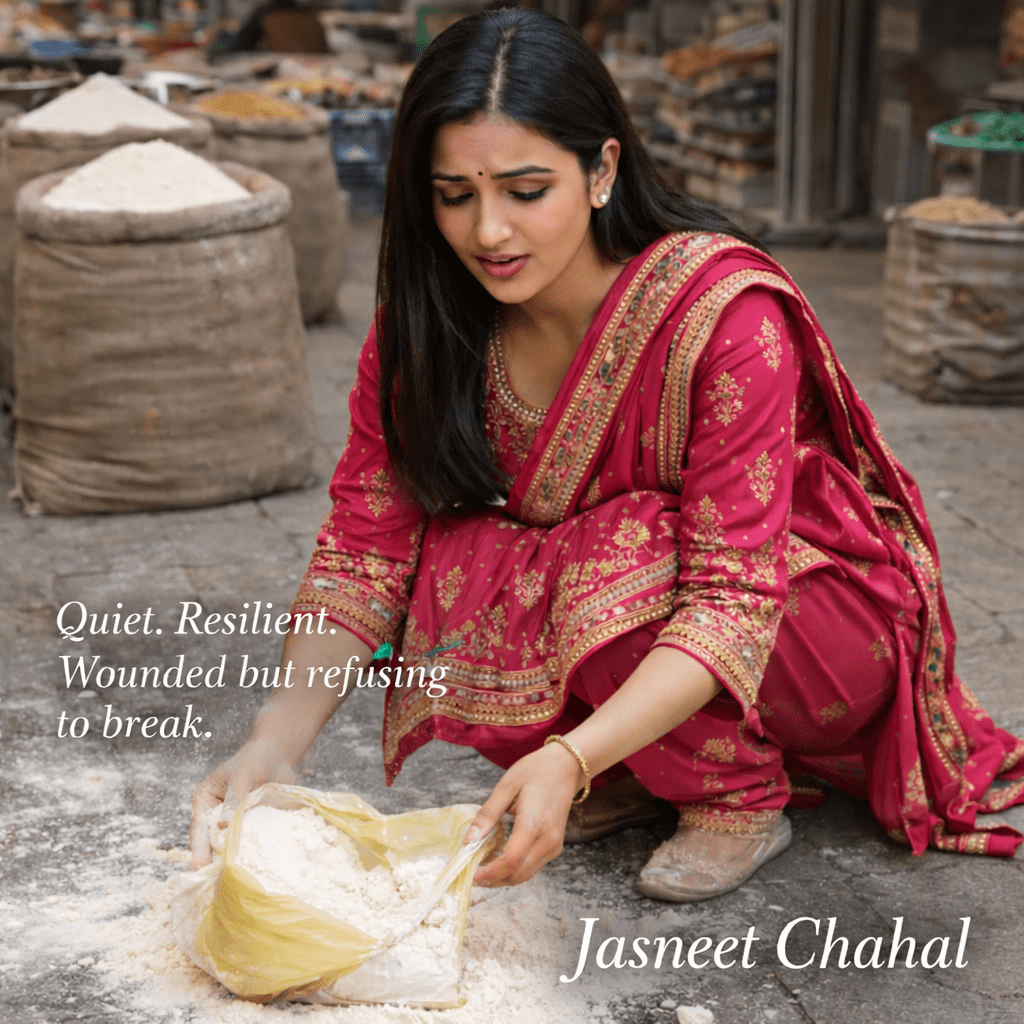
She dropped a packet of flour. It burst open at her feet.
White powder everywhere.
She froze — because mistakes always led somewhere unpleasant.
He bent down automatically.
“It’s okay,” he said, gathering what he could.
She looked at him for the first time.
He didn’t look at her like a man assessing a woman.
He looked like someone tired.
“You okay?” he asked.
The question caught her off guard.
“I’m fine.”
He smiled slightly. “I’m not.”
That honesty felt almost illegal.
They stood there awkwardly for a second longer than necessary.
“I’m Jasneet.”
“Veer.”
Something quiet passed between them.
Not attraction.
Recognition.
They walked away in opposite directions.
Both thinking about it.
Chapter 4 — Accidental Meetings
They saw each other again three days later.
Same market. Same tea stall.
Neither admitted they had hoped.
They talked about music first.
“What kind of songs do you like?” he asked.
“The ones that feel like someone actually meant it.”
He laughed softly. “So not half of what’s playing these days.”
That made her smile.
It had been a while since she’d smiled without checking who was watching.
They started meeting twice a week.
Then more.
They didn’t flirt.
They talked.
About lyrics.
About how commercial music felt hollow.
About how sometimes you feel trapped but don’t know how to explain it.
One evening she said quietly, “I’m married.”
He nodded. “Me too.”
Silence sat between them.
“It’s not good,” she admitted.
“Same.”
They didn’t give details at first.
Just fragments.
Control.
Humiliation.
Distance.
No intimacy.
No safety.
They didn’t touch.
But something had already shifted.
For the first time in years, both of them felt seen.
Chapter 5 — The Call
They exchanged numbers reluctantly.
At first, just voice notes about lyrics.
Then short calls.
One night she stood on the balcony whispering while Sandeep slept inside.
Veer read her a hook he’d written:
“A house full of people, but no one home.”
She felt that line inside her ribs.
“You should sell that,” she said softly.
“You think anyone would buy it?”
“I would.”
Behind her, the balcony door opened.
Sandeep didn’t shout.
He took the phone.
Looked at the screen.
Then slapped her.
Across Jalandhar, Preeti saw Veer smiling at his phone and threw it against the wall.
“What do you think you’re doing?”
“Talking.”
“To who?”
He didn’t answer fast enough.
That night both of them lay awake in pain.
At 3:12 a.m., Veer texted from an old phone.
We can’t live like this.
At 3:14 a.m., she replied.
Then we don’t.
Chapter 6 — Leaving
They met near a small temple early morning.
Both with one bag.
No drama.
Just fear.
“Are you sure?” he asked.
“No,” she said honestly. “But I’m done.”
They rented a tiny room near BMC Chowk.
One bed. One chair. One window that actually opened.
They didn’t rush into romance.
They healed first.
Silence felt different there. It wasn’t heavy. It was breathable.
Slowly, they started writing again.
Together.
Late nights. One laptop.
He would write emotion. She would structure it.
They sold a lyric to a local singer.
Then another.
Small money.
But clean money.
Earned without shame.
For the first time in years, Jasneet slept without fear of footsteps.
For the first time, Veer woke without dread.
Chapter 7 — They Find Each Other
Sandeep searched angrily.
Preeti searched louder.
Eventually they crossed paths at a police complaint counter.
“You’re looking for your spouse?” Preeti asked sharply.
“Yes.”
“They ran.”
“Mine too.”
Anger recognized anger.
They started searching together.
Not out of love.
Out of wounded pride.
“They’ll regret it,” Sandeep muttered.
Preeti smiled darkly. “I’ll make sure.”
Chapter 8 — The Confrontation
It happened outside a recording studio in Jalandhar.
Late evening.
Jasneet and Veer were walking out laughing — relaxed in a way they hadn’t been in years.
They heard their names like accusations.
Sandeep.
Preeti.
The air tightened.
“You think you can run?” Sandeep growled.
Preeti stepped forward without warning.
The knife appeared fast.
Jasneet gasped as pain spread across her back.
Veer caught her.
Everything inside him snapped.
He grabbed a stone from the roadside.
Raised it.
Preeti looked up at him — defiant even now.
He could end her.
Right there.
Jasneet’s voice came weak but clear.
“Veer… don’t.”
His arm trembled.
“This isn’t you,” she whispered.
The rock slipped from his hand.
That was the moment he chose who he would be.
Gunshots cracked the air.
Preeti fell first.
Then Sandeep.
Preeti’s mother stood shaking, gun in hand.
“I didn’t raise you to destroy people,” she cried.
Across from her, Sandeep’s mother lowered her own weapon.
“I warned you,” she whispered to her son.
Sirens approached.
Veer held Jasneet tightly as everything blurred.
Chapter 9 — Hospital
The knife had missed her spine by inches.
Veer sat beside her hospital bed in Jalandhar Civil Hospital for three nights straight.
He barely slept.
When she finally opened her eyes fully, she looked at him and whispered:
“You didn’t do it.”
“No.”
“Good.”
He pressed his forehead gently against her hand.
“I almost did.”
“But you didn’t.”
That mattered more than survival.
Chapter 10 — Marriage
They married quietly.
No big wedding.
No crowd.
Just signatures and two witnesses.
They didn’t want noise.
They wanted peace.
They moved into a modest but warm house in Jalandhar.
Windows open.
Curtains light.
Air moving freely.
They kept writing.
Selling songs.
Building slowly.
They never rushed into children.
One evening on their rooftop, she leaned against him and said,
“Do you ever regret leaving?”
“No.”
“Even after all that?”
“We didn’t leave,” he said softly. “We survived.”
Chapter 11 — Enough
Years later, they were known in the Punjabi music industry.
Not celebrities.
But respected writers.
Their songs carried something real.
Pain that had lived somewhere.
One evening, sitting together after finishing a new track, Jasneet said,
“We were never lucky.”
Veer smiled.
“No.”
“We just chose ourselves.”
They didn’t need anything else.
Not revenge.
Not children.
Not approval.
Just quiet nights.
Shared work.
And a life that belonged to them.
Outside, Jalandhar moved the way it always did.
Traffic.
Vendors.
Noise.
But inside their home, there was something rare.
Safety.
And for them—
That was enough.


 Davinder Ranu
Leave a comment